Why Hawaii's terrain and workforce produce knee injuries at rates mainland clinics don't see, how to identify what's actually damaged, and the interventional treatments that get you back on your feet without surgery or opioids.
Hawaii's combination of physically demanding industries, volcanic terrain, and year-round outdoor activity produces knee injuries in patterns that differ from the mainland. Construction workers kneel on uneven lava rock. Hotel housekeepers climb stairs hundreds of times per shift. Hikers descend 3,000-foot elevation drops on loose volcanic trail surfaces. Surfers absorb sudden lateral forces on pop-ups over shallow reef. The knee absorbs all of it.
The knee joint is the largest and most mechanically complex joint in the body. It handles compressive loads of 2-3 times your body weight during walking, 5-6 times during stair climbing, and 7-8 times during squatting or kneeling. Add external loads (carrying supplies up stairs, lifting materials from the ground, absorbing a sudden twist on uneven terrain) and the forces on the meniscus, ligaments, and cartilage surfaces escalate rapidly.
| Industry | High-Risk Activities | How the Knee Gets Damaged |
|---|---|---|
| Construction | Kneeling on concrete and lava rock, climbing ladders and scaffolding, squatting for low-level work, carrying heavy loads up slopes | Direct compression of the kneecap and bursa against hard surfaces (prepatellar bursitis). Meniscus tears from twisting under load. Ligament sprains from falls and sudden directional changes on uneven terrain. Cumulative cartilage wear from years of loaded squatting. |
| Hotel & Hospitality | Stair climbing between floors, squatting to clean low surfaces, kneeling to make beds, carrying laundry carts, standing on hard floors 8+ hours | Repetitive stair loading degrades meniscus and cartilage over time. Patellar tendinopathy from thousands of squat-and-stand cycles per week. Cumulative overload on a joint that never gets adequate recovery time between shifts. |
| Agriculture | Squatting for low crops, walking on uneven field terrain, kneeling for planting and weeding, operating machinery with repetitive pedal use | Sustained deep flexion compresses the posterior meniscus and stretches the cruciate ligaments. Uneven terrain produces unexpected lateral forces that stress the collateral ligaments. Vibration from equipment accelerates joint degeneration. |
| Warehouse & Harbor | Squatting to lift boxes from floor level, climbing in and out of containers, operating forklift pedals, pushing heavy carts | Heavy loaded squats are the single most damaging activity for knee cartilage. The combination of compressive force and rotation during lift-and-turn maneuvers tears meniscus tissue. Forklift operators develop patellar tendinopathy from sustained pedal pressure. |
| Healthcare | Kneeling beside patients, squatting to access low equipment, transferring patients, standing on hard floors during long shifts | Sudden knee loading during patient catches and unexpected weight transfers. Cumulative wear from repetitive kneeling and squatting throughout the shift. |
Outside of work, Hawaii's geography produces knee injuries through mechanisms that are uncommon on the mainland.
Hawaii's trails involve extreme elevation changes on loose, uneven volcanic surfaces. Descending is where the knee damage happens. Walking downhill generates eccentric loading on the quadriceps tendon and patellar tendon as the muscles contract while lengthening to control your descent. On a trail like Kalalau (dropping 1,200 feet in 11 miles of uneven terrain), Pololu Valley (a 400-foot descent on loose rock), or the Aiea Loop (rolling terrain with root-covered switchbacks), the cumulative eccentric load on the knee during a single hike can exceed what a flat-terrain runner experiences in a week.
The result: patellar tendinopathy (inflammation of the tendon below the kneecap), iliotibial band syndrome (pain on the outside of the knee), meniscus irritation, and premature cartilage wear in regular hikers who descend frequently without adequate recovery.
The pop-up motion places sudden rotational stress on the knee as the surfer transitions from prone to standing. The lead knee absorbs a rapid valgus (inward) force, especially on shortboards where the stance is narrow and the rotation is explosive. Over thousands of pop-ups, the medial meniscus and MCL take cumulative damage. Acute MCL sprains and meniscus tears happen during wipeouts, reef contact, and awkward landings on late drops.
Water polo (eggbeater kick produces chronic patellar tendinopathy and hip-knee kinetic chain problems), tennis and pickleball (sudden lateral movements stress the collateral ligaments), running on crowned roads (camber creates asymmetric loading), and gym training (squat and lunge injuries) all contribute to Hawaii's year-round knee injury volume.
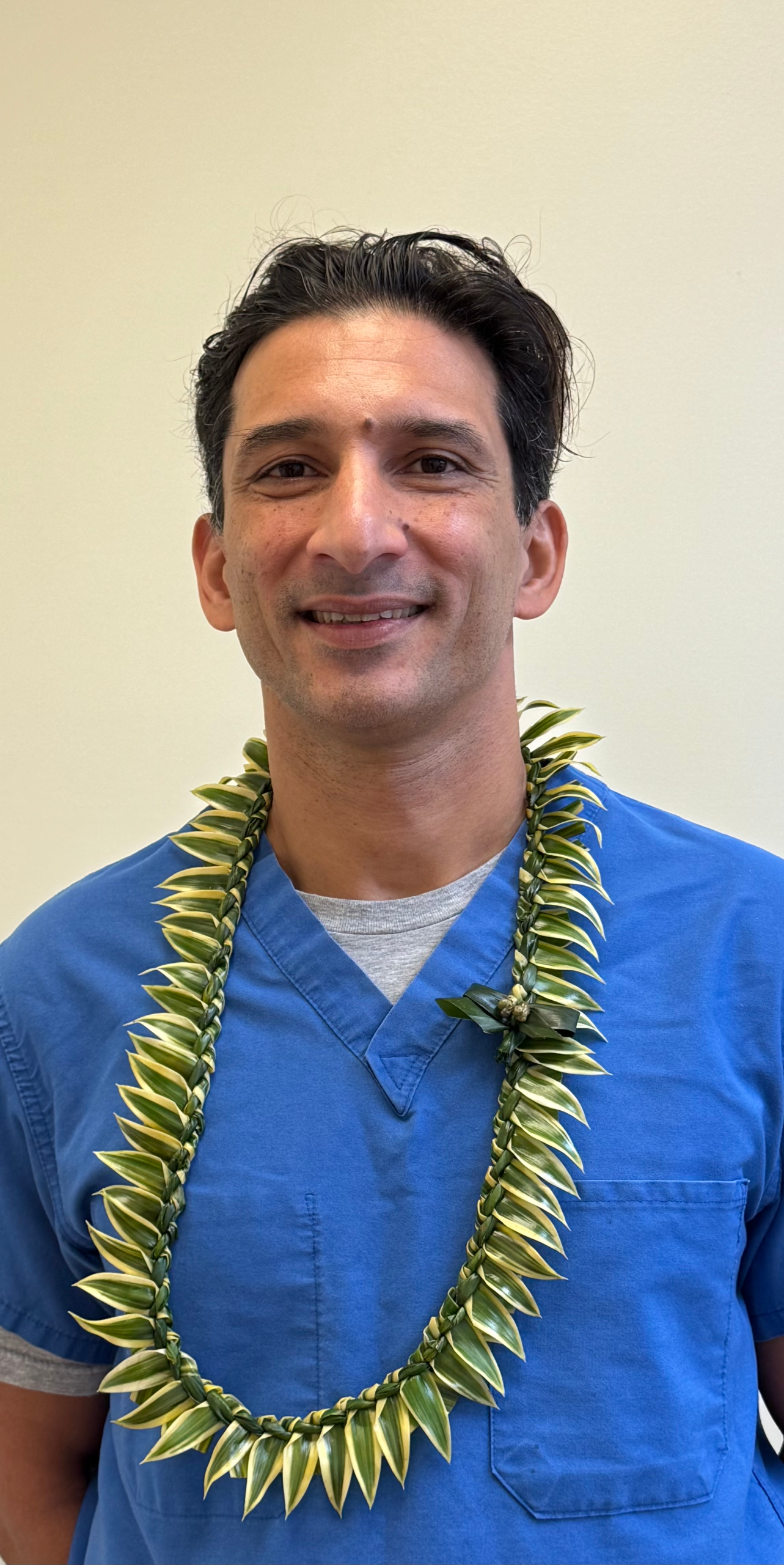
If your knee was injured at work, it's a workers' compensation case and VMG handles all the documentation and billing. If it happened hiking, surfing, or at the gym, the same treatments are available. Either way, Dr. Vally diagnoses the specific structure that's damaged and builds a treatment plan to repair it without surgery or opioids.
| Diagnosis | What It Is | Typical Cause in Hawaii |
|---|---|---|
| Meniscus tear | Tear in the C-shaped cartilage that cushions the joint between the femur and tibia. Causes catching, locking, swelling, and pain with twisting | Twisting under load (construction lifts, surfing wipeouts), cumulative compression from deep squatting, age-related degeneration accelerated by occupational loading |
| Patellar tendinopathy | Chronic inflammation and degeneration of the patellar tendon (below the kneecap). Pain worsens with stairs, squatting, and jumping | Repetitive stair climbing (hospitality workers), squatting and kneeling (construction), running downhill (hikers), eggbeater kick (water polo) |
| Knee osteoarthritis | Progressive cartilage loss in the joint, producing pain, stiffness, and reduced range of motion that worsens over years | Cumulative occupational loading from construction, warehouse work, and agriculture. Accelerated by prior injuries, obesity, and years of heavy physical labor |
| MCL/LCL sprain | Stretching or tearing of the medial or lateral collateral ligaments on the inner or outer sides of the knee | Lateral force during falls (construction), contact or twisting during sports (surfing, water polo), awkward landings on uneven terrain |
| Prepatellar bursitis | Swelling of the fluid-filled sac in front of the kneecap. Known as "carpenter's knee" because kneeling is the primary cause | Direct kneeling on hard surfaces (construction on concrete and lava rock, tile work, plumbing, electrical rough-in at floor level) |
| IT band syndrome | Pain on the outside of the knee caused by the iliotibial band snapping over the lateral femoral condyle with repetitive flexion and extension | Downhill running and hiking (eccentric loading tightens the IT band), cycling, and any activity with high-volume repetitive knee bending |
| ACL injury | Partial or complete tear of the anterior cruciate ligament, producing instability and giving-way episodes | Sudden deceleration, pivoting, or landing from a jump. Common in sports but also occurs during falls on construction sites |
Many knee conditions respond to non-surgical interventional treatment, including some meniscus tears, all grades of tendinopathy, early to moderate osteoarthritis, ligament sprains, bursitis, and IT band syndrome. ACL tears with complete rupture typically require surgical reconstruction for active patients, but partial tears and many meniscus tears can be managed conservatively.
| Treatment | How It Treats Knee Injuries |
|---|---|
| PRP Therapy | The gold standard non-surgical treatment for knee osteoarthritis and chronic tendinopathy. Concentrated growth factors from your own blood are injected into the joint or tendon under ultrasound guidance. For osteoarthritis, PRP reduces inflammation, improves joint lubrication, and may slow cartilage loss. For patellar tendinopathy, PRP stimulates tendon fiber repair at the structural level. Multiple studies show PRP outperforms corticosteroid and hyaluronic acid injections for knee osteoarthritis at 6 and 12 months. |
| Corticosteroid Joint Injection | Delivers anti-inflammatory medication directly into the knee joint under ultrasound guidance. Provides rapid pain relief (typically within 24-48 hours) and a window of significantly reduced inflammation that allows rehabilitation. Particularly effective for acute flare-ups of osteoarthritis, bursitis, and inflammatory joint conditions. Often used as a bridge: corticosteroid for immediate relief while PRP works on longer-term structural repair. |
| Trigger Point Injection | Addresses the muscular component of knee pain. The quadriceps, hamstrings, IT band, and calf muscles often develop painful trigger points secondary to knee injury as the body compensates for joint dysfunction. Releasing these trigger points reduces referred pain, restores muscle function, and improves knee mechanics. |
| Diagnostic Ultrasound | In-office ultrasound allows Dr. Vally to visualize the knee structures in real-time during the evaluation: meniscus integrity, ligament status, tendon thickness, joint effusion (swelling), and Baker's cyst formation. This provides immediate diagnostic information without the cost and scheduling delay of an MRI. If an MRI is needed for surgical planning, the ultrasound findings guide the referral. |
| Guided Rehabilitation | Specific exercises prescribed for your diagnosis. Meniscus tears require different rehab than patellar tendinopathy, which requires different loading protocols than osteoarthritis. Dr. Vally writes the specific protocol: which exercises, what loads, what progressions, and what to avoid. Generic "strengthen your quads" instructions are inadequate for structured knee recovery. |
PRP vs. cortisone for knee osteoarthritis: Corticosteroid injections provide faster initial relief (days vs. weeks), but the effect diminishes with repeated injections and there is evidence that frequent cortisone injections may accelerate cartilage loss over time. PRP therapy takes longer to produce results (2-6 weeks) but addresses the underlying tissue damage and shows sustained improvement at 6 and 12 months in clinical trials. For many patients, the optimal approach is one corticosteroid injection for immediate relief followed by PRP for longer-term structural benefit.
Not every knee injury can be treated without surgery. Recognizing the situations where surgery is the right path prevents wasted time on conservative treatments that won't work for that particular injury.
Complete ACL rupture in active patients who need lateral stability for work or sport generally requires surgical reconstruction. Without a functioning ACL, the knee gives way during pivoting and cutting movements, making construction work, hiking, and most sports unsafe.
Locked knee from a bucket-handle meniscus tear. When a large meniscus tear flips into the joint and prevents the knee from fully straightening (mechanical locking), arthroscopic surgery is usually needed to repair or remove the displaced fragment.
End-stage osteoarthritis where cartilage is completely gone (bone-on-bone) and interventional treatments have been exhausted may ultimately require partial or total knee replacement. This is typically a decision made after conservative treatment has been given a reasonable trial.
When surgery is indicated, Dr. Vally refers to an orthopedic surgeon and continues managing the workers' compensation documentation, post-surgical pain management, and return-to-work coordination. The WC case stays with VMG even when a specialist performs the surgery.
Knee injuries are among the most common lower extremity workers' compensation claims in Hawaii. Both acute injuries (a single fall, twist, or impact) and cumulative injuries (progressive cartilage and meniscus damage from years of occupational loading) are compensable.
Insurance carriers routinely argue that knee osteoarthritis and meniscus tears are age-related degeneration, not work injuries. MRI findings of "degenerative changes" appear in nearly every knee over 40, which gives carriers a convenient basis for denial. But age-related degeneration does not mean the condition is not occupational.
Under Hawaii law, if your work activity aggravated, accelerated, or combined with pre-existing degeneration to produce symptomatic knee disease, the resulting condition is compensable. A construction worker who kneels on concrete for 20 years develops osteoarthritis faster and more severely than an office worker of the same age. The work caused the acceleration. That acceleration is the compensable injury.
The medical record must clearly establish this connection: what specific work activities loaded the knee, how often and for how long, the biomechanical mechanism by which those activities accelerate cartilage wear beyond normal aging, and objective findings showing damage consistent with occupational loading patterns. Dr. Vally writes this level of documentation for every knee injury claim.
Your right to choose your doctor: If your employer or the insurance carrier hands you a provider list after a knee injury, you are not required to see anyone on that list. Under Hawaii law (HRS 386-21), you choose your own treating physician. For a complete overview of the claims process and your rights, see the Hawaii Workers' Compensation Complete Guide.
| Location | Address | Knee Treatments Available |
|---|---|---|
| Kona | 81-6587 Mamalahoa Hwy, Kealakekua, HI 96750 | Ultrasound diagnosis, joint injection, PRP, trigger point injection, IR sauna, PENS/TENS |
| Hilo | 82 Puuhonu Pl, Suite 202-203, Hilo, HI 96720 | Ultrasound diagnosis, joint injection, PRP, trigger point injection, HBOT, PENS/TENS |
| Lihue | 2978 Haleko Rd Suite B, Lihue, HI 96766 | Ultrasound diagnosis, joint injection, PRP, trigger point injection, HBOT, PENS/TENS |
| Kihei | 310 Ohukai Rd Suite 309, Kihei, HI 96753 | Ultrasound diagnosis, joint injection, PRP, trigger point injection, PENS/TENS |
All locations accept Hawaii workers' compensation insurance and OWCP for federal employees. Call (808) 935-6353 to schedule an evaluation.
Vally Medical Group treats knee injuries with opioid-free interventional medicine. PRP therapy, ultrasound-guided joint injections, and targeted rehabilitation. We handle the workers' comp documentation. Four Neighbor Island locations.
Schedule Your Knee Evaluation →(808) 935-6353 • Monday–Friday 8am–4pm • All locations
PRP Therapy • Injection Therapy • Ultrasound-Guided Procedures • Sports Medicine • Rotator Cuff Treatment • Construction Worker Back Pain • Sciatica Treatment • Return to Work Programs • Right to Choose Your Doctor • Workers' Compensation Guide
Disclaimer: This article is provided for informational and educational purposes only and does not constitute medical advice. Knee injury severity, treatment options, and outcomes vary between individuals. For diagnosis and treatment, consult a qualified physician. For questions about your workers' compensation rights, consult a Hawaii workers' compensation attorney.